

Thou Mayest
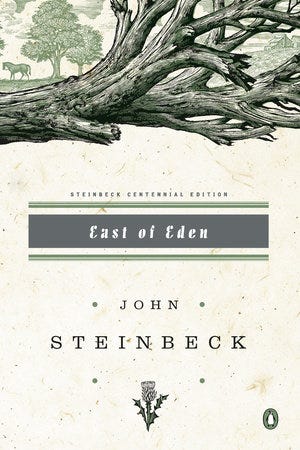
My fourth time(?) through East of Eden, and the two chapters I keep coming back to
I am back in the Salinas Valley again. Fourth time (I think). Every two or three years, it pulls me back, and I let it.
I do not reread many novels. Life is long but not that long, and there is always a new stack (of mostly old books) waiting. A few books earn the return trip, and this one sits at the top of the short list of fiction that changed how I experience our world. Steinbeck wrote a lot of great books. This is the one I would save from a fire.
Two chapters keep me coming back. 22 and 24. My humble opinion? They belong among the most important chapters ever written in fiction, and they work as a pair. 22 opens the question. 24 answers it. Also, spoiler alert (sort of). If you’ve never read East of Eden but are interested in it, maybe don’t read this week.
Chapter 22 is the naming scene. Adam has collapsed into himself after Cathy shot him and walked out, and he has left his twin boys unnamed for more than a year, effectively quitting on his own life. Samuel Hamilton (neighbor and badass) rides out, takes one look at the wreck of the man, and knocks him to the floor with a single punch. Then he says the plain thing. The children need names. The ranch needs a man. Grief is not a permit to quit living. It is one of the great acts of friendship in the book, and there is not a soft word in it.
That night, the three of them, Samuel, Adam, and Lee, sit down to name the boys, and the talk turns to Genesis and the story of Cain and Abel. They read it aloud. Lee, who has played the quiet servant in the corner for most of the book, turns out to have been carrying this story around for years. He calls it the best-known story in the world because it is everybody’s story, the symbol story of the human soul.
At some point, he starts to explain why it cuts so deep. The greatest terror a child can have is that he is not loved, and rejection is the hell he fears. With rejection comes anger, and with anger, some kind of crime in revenge for the rejection, and with the crime, guilt, and there is the story of mankind. Cain is rejected, and Cain kills his brother. Lee calls the whole thing a chart of the soul, the secret, rejected, guilty soul.
The problem with the passage that makes it so incredible is a translation problem. When God speaks to Cain about the sin crouching at his door, the translations read that evening do not agree. One says thou shalt rule over it, a promise that the man will beat the thing. Another says do thou rule over it, an order that he must. A promise and a command are not the same, and Lee cannot let it rest. What a man is, whether he is owed his victory, commanded to it, or handed something else entirely, comes down to a single verb. That is where 22 leaves you. The door is there, and no one has walked through it yet.
Chapter 24 is where the door gets kicked open.
It comes 10ish years later, near the end of Samuel’s life. He rides out to the Trask house to say goodbye, knowing it’s his last, and Lee reminds him of the night they spent together, naming the twins, and how one phrase drove him to years of study. He had taken the question to the old Chinese men of his family association in San Francisco, learned elders, and they had brought in a rabbi and bent themselves to Hebrew for two years to settle two words. Two years, for two words.
What they found was timshel. Thou mayest.
Not thou shalt. Not do thou. Thou mayest. Lee, usually so contained, can barely hold what it means. It gives a man a choice. He describes it as the most important word in the world. It says the way is open. Then he turns it from comfort into something with teeth: for if thou mayest, it is also true that thou mayest not.
This is the passage Steinbeck built the whole book around, and it is given as a choice. Lee sets the ordinary man against the great one. There are millions in their sects and churches who feel the order, do thou, and throw their weight into obedience. There are millions more who feel predestination in thou shalt, certain that nothing they do can change what will be. Two ways to go small. Obey because you were told, or coast because it is all settled anyway. Then the turn. “But ‘Thou mayest’! Why, that makes a man great, that gives him stature with the gods, for in his weakness and his filth and his murder of his brother, he has still the great choice. He can choose his course and fight it through and win.”
The mediocre man hands his life to the order or to the fate, and is relieved to be rid of it. The great man takes the choice, knowing the same word that lets him win is the word that lets him lose, and fights it through anyway. The cost is built into the gift. Thou mayest is also thou mayest not, and most people, handed a door that can be walked through or walked past, walk past it, because choosing is the harder and more frightening thing.
Almost everything I believe about how life works hangs on that one word. What makes a person great, what makes love hold, what makes a life worth the trouble of living it. All of it sits on the idea that we are not run on rails. At the hard moments, each of us gets to choose. All it took was one of America’s finest authors, a fictional Chinese servant, and his imagined scholars to walk me to it.
I finished Chapter 24 again this week, and the idea landed as hard as it ever has. It is extraordinary to me that I can sit in a chair on an ordinary morning, recovering from a cold plunge, and receive something this good from a man who died decades before I was born. Steinbeck thought harder about this than I ever will. He found language for it that I could not find on my best day. And he left it on the page for anyone willing to slow down and take it.
There is something humbling and freeing in that at once. I spend my days trying to put words to things, to make ideas land for other people. Then I open a book like this and remember how far the ceiling really is. How much stronger the thinking can be. How much I get to inherit by reading people who saw further than I do.
I reread for this. Not to be entertained, though I am. To sit again with ideas better made than anything I can conjure, and to let them do their slow work on me. A great book does not give you its best on the first pass. It waits. It meets you at thirty and forty and again at forty-five, and says something different each time, because you are different each time, and the words held more than you could carry the first time through.
The idea of the choice we all get, each day, in small and insignificant ways. It is true in the arc of a character in a novel, and just as true in the unglamorous decisions of a Tuesday. Most of what matters in life is neither handed to us nor forced on us. It is offered. We decide what we build and what we let crouch at the door. Thou mayest. The door is open. You walk through it, or you do not.
Read East of Eden. Read it on the page if you can, or put it in your ears through Audible if that is how the book finds you. How it reaches you does not matter. Meeting these people does. You will find a cast and a story that are at once wildly specific and completely universal, the rare trick only the best books pull off. It is hard to overhype, so I am not going to try to be measured about it.
Between East of Eden and Lonesome Dove (with a Cormac McCarthy novel or two thrown in), I have my own highlight reel of fiction. Enough to carry me the rest of my life. I read plenty else, and I am glad I do, but those two alone are enough to go back and forth on, to chew on over and over, and to find something new every time.
I will finish East of Eden again this week. In a few years, I will start it over. I can’t wait.
-ap