

4+4
Five weeks from an idea to ten leaders climbing out of the trough together
A few hours into our first afternoon together, one of the most accomplished people in the room nearly walked out.
She’s spent her whole career being one of the most prepared people in every room she enters. The one with the answer. The one the others lean toward.
And there she was, looking up from a screen, saying out loud, to all of us, that there was no way she could do this.
I’ve rarely been happier in a working moment of my life.
Because I knew exactly where she was standing. I’d stood there myself, not long ago, and I wrote about it here earlier this spring. The strange, weird thrill of being conscious of my own incompetence again at forty-five. The leadership square. That honest, uncomfortable walk from not knowing what you don’t know… to knowing, all at once, how much you don’t.
She was at the precipice of it.
She had no idea yet how fast the bottom of the square was coming.
Five weeks ago, this experience was an inkling.
An idea that surfaced after a board meeting and was still forming on the following Tuesday morning. For months I’d been hearing the same question from executives, over and over. Not “what is AI.” Something quieter than that, and more vulnerable. How do I actually learn to do this myself? Without another strategy deck? Without pretending I already have?
So we built an answer, fast. Four days, in person. Ten seats. CEOs and presidents who were finished with theory.
We weren’t sure there was a there there.
Five weeks later, ten of them flew into DC at the Gallup world headquarters and handed us four days of their lives. The experience, tools and training modules they spent those days building inside of didn’t exist four weeks ago. That’s not a figure of speech. They were literally built in the few weeks before they were experienced.
There’s something incredible that happens when an idea becomes a room full of people. I’ve felt it a few times now, just never this quickly. I’m still not used to it.
Ten executives. Four days. An idea that had been a single line in a post here in April.
Every person in that room had lived through technology rollouts before.
A new CRM. A new ERP. A new suite of something, arriving with a training, an adoption curve, a help desk. A slow walk toward competence on a tool whose ceiling you could see from the floor.
They came in braced for a faster, smarter version of that (I think).
It took about a day for the floor to drop out.
One of them said it better than I could have. We’ve spent twenty-five years, he said, being trained that the help bar is the least useful thing on any tool we own. We learned to treat it as a punchline. You never go to the help bar.
And then he said the part we keep coming back to as a company:
This is not a tool. It’s a capability. Those are fundamentally different things.
A new tool makes you faster or better at the work you already know how to do. A new capability changes what you’re able to do entirely. You can’t learn a new capability by being told about it. I can describe it, and you’ll nod, and you won’t believe me… not until your own hands have done something they could not do the week before. We’ve all gained the ability to fly, but most of us will still jump expecting to come straight back to the ground. Now we float for a moment, and its terrifying.
The experience of this new capability isn’t optional. It never was.
Nobody warns you what it looks like to watch genuinely capable people learn something new.
It looks like a small grief.
These are leaders who have earned their seats. Twenty plus years, most of them, spent becoming the most competent person in the building. Knowing isn’t just their skill. It’s their identity.
And there they were, on day one, hunched over screens like college students on the first day of Finance 401. Going quiet. Getting it wrong, then wrong again. Asking the question they were faintly embarrassed to ask out loud.
I have a soft spot for that exact moment. It’s the most honest a leader ever lets themselves be.
There’s a loneliness built into leadership. The further out on the ledge you go, the fewer people are out there with you, and the harder it gets to admit to anyone that you’re lost. This whole experiement of writing every week exists because I think more of us need to stand against that loneliness.
What I watched in that room was ten people set it down at the same time.
Nobody was the expert. Everybody was in the trough. And the trough, it turns out, is a far less lonely place with nine other people already standing in it.
And then, somewhere around hour thirty, the room changed.
Not with a bang. It’s quieter than that. You see it in posture first. The shoulders come down. The hunch turns into a lean. The questions stop apologizing for themselves before they arrive.
Conscious incompetence becoming conscious competence. You can watch it move through a person in real time.
Let me give you one small example, because the point was never the actual building that took place.
He’s a principal in a lending company. Two partners. No technical background of any kind, the kind of leader who has always hired the technical people instead of becoming one.
By the last morning, he had built an integrated dashboard that pulled in a dozen critical sources to track loan delivery across tens of vendors.
He’d given it a name. He talked about it as if he were a colleague who had just started. It reads email. It reads documents. It reaches into a dozen scattered places that nobody in the company had ever managed to connect, and it pulls them all into a single, living picture of their entire loan portfolio.
He estimated it repsented at least three full-time analysts worth of work. Something like three hundred thousand dollars plus a year in salary.
Built by a man who, six months earlier, would have laughed at the suggestion that he could even dream of something like this.
He thinks he can triple his business in eighteen months without hiring another person. I believe him. But that’s not the part that stayed with me.
The part that stays with me is that he talked about it as if it were ordinary. Not a project. Not a pilot he’d report on later. Just… how he works now. A new ceiling, and he was already standing under it as though it had always been there.
Another one told us he’d started waking at five in the morning. Going to his home office in the dark. Not from stress. From the opposite of stress. He couldn’t wait to get back to it.
Four days isn’t a finish line. It’s a trailhead.
Everything I watched was real and represented someone discovering the capability to fly (perhaps only the first six inches off the ground, but lfy none the less).
One of the leaders said exactly that about himself near the end. He was hovering, he said. Six inches up. Floating, not flying. Cool… and now what?
That “now what” is the right question, and it doesn’t have a four-day answer.
The capability we’re actually handing people isn’t technical. The tools are a commodity. Anyone with a hundred dollars a month has access to the very same ones. What took four days of real struggle to even begin moving was something slower. Learning agility. Sense-making. The nerve to sit inside uncertainty without flinching out of it. The judgment to tell work that is correct from work that is merely plausible. The willingness to trust frameworks and shared language so we can collectively have a conversation about what is actually possible, divorced from Wall Street Journal articles breathlessly touting agentic workflows and AI Armageddon.
None of this capability comes from articles. It’s earned, the slow way, and it’s the actual engine under all of this.
Every organization serious about this will walk its own people through that same trough. There’s no door around it. The work ahead isn’t learning a tool. It’s rebuilding how the work itself is done. Who does what. What a team is for. What a meeting actually costs.
There’s a long climb to AI adoption no one is talking about. We’re at the bottom of it.
Those ten people know that now. They’re carrying it home with them (along with their own Mac Mini).
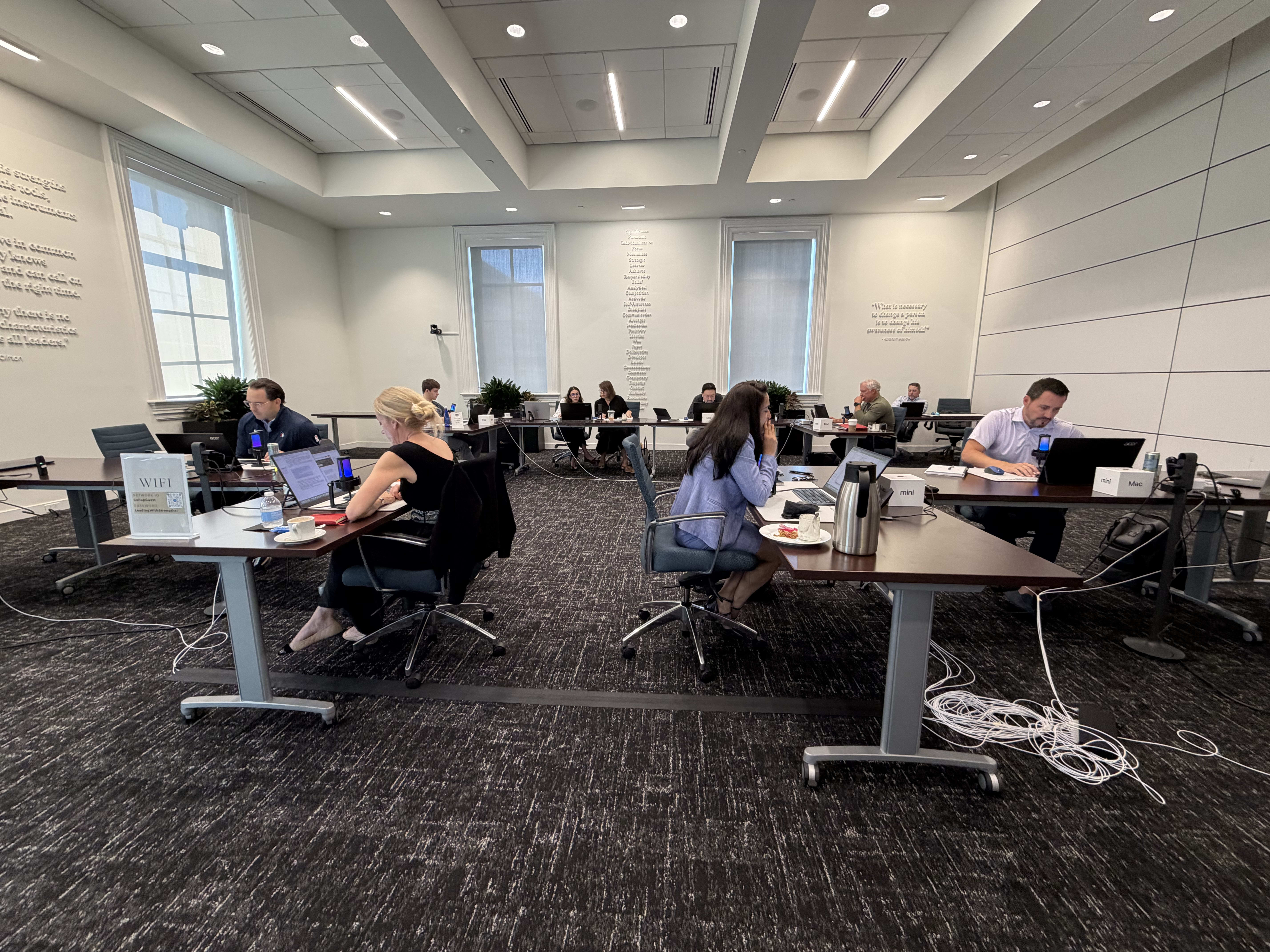
I don’t think I’m doing these last four days justice. You had to be in the room. In the trough. With your own hands on it.
We opened the next set of cohorts yesterday for the rest of this year. We haven’t made them public yet, and the waitlist has started filling anyway, just like the first one did. I don’t know who you are or why you’re still reading, but if you lead a company and are interested, go to executive.silent.partners and join the waitlist for any dates you’d like.
I’m someone who cries fairly easily. That won’t surprise those of you who know me.
I came close at the end of the last morning, standing up to thank ten people who had let themselves be beginners, in front of one another, for four days straight.
They jumped off the ground this week. The flying is all still ahead of them. Every bit of it.
But they jumped. And they know now that they can fly. That kind of knowing doesn’t come back out of a person once it’s in.
Somewhere ahead of you is your own version of that first afternoon. The screen you can’t make sense of. The question you’re embarrassed to ask. The moment you become conscious, finally, of how much you do not know. And it doesn’t have to have anything to do with AI adoption.
I hope you walk straight toward it.
That’s where the good stuff of life starts. Happy friday friends.